Scalloped Hammerhead
Sphyrna lewini
A large, notched-head hammerhead of the coastal and nearshore ocean in warm months — a boat catch under federal size and vessel limits.
Typically present
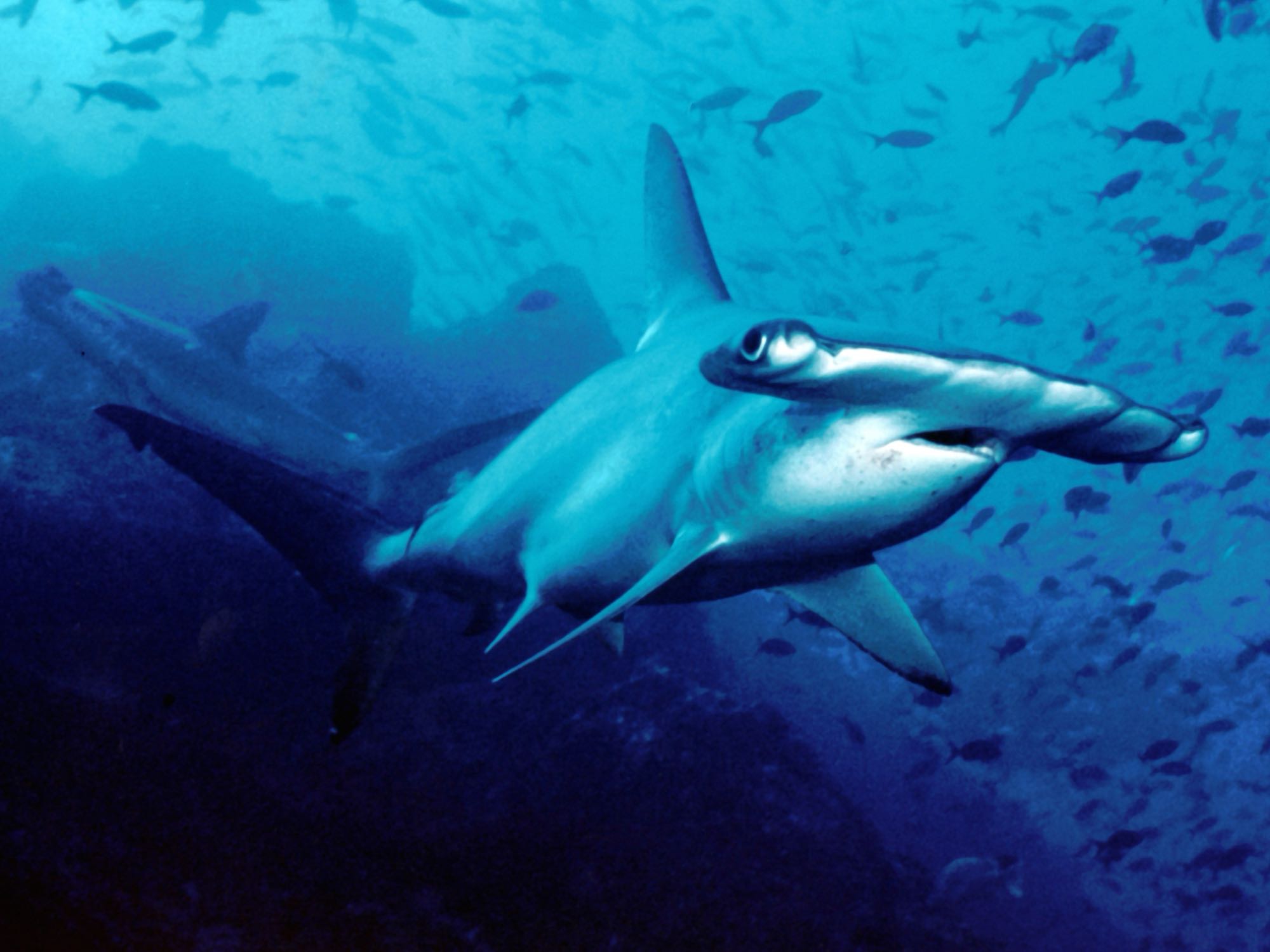
Photo: Barry Peters — CC BY 2.0
- Habitat
- Methods
- Inshore boat
- Difficulty
- advanced
- Eating
- fair
Identification
Look for
- Hammer-shaped head with a pronounced, curved notch (scallop) at the midpoint and 4 bumps across the front edge — more curved and less straight-edged than great hammerhead's head
- Distinguishes it from bonnethead shark's smooth, unnotched, shovel-shaped head — a completely different, much smaller 'small coastal shark' species
- Can reach up to 11 feet and 335 lbs
Local waters
Coastal and nearshore waters
Primarily a boat fishery here — typically fished by inshore boat.
When to fish
Warmer months, in coastal and nearshore Virginia waters — NOAA's documented western Atlantic range runs from New Jersey to Florida, directly including the Virginia coast.
Water temperature
The water, not the calendar, sets the season here — a warm October or a cold snap moves these bands.
Water temperature and the seasonsHow to catch it
Primarily a boat fishery here — typically fished by inshore boat. Technique notes for this species have not been written yet; the baits and rigs below are the documented starting points.
Bait & lures
- Cut or live fish bait on circle hooks, typically from a boat
On the table
Eat with caution — check current Virginia fish consumption advisories for the specific waterbody before eating.
- The Virginia-encountered Northwest Atlantic population is federally confirmed open as of 2026-08-18: 78" fork-length minimum size, 1 shark total per vessel per trip, and cannot be retained if swordfish, tuna, or billfish are already aboard that trip. This is a real, important-to-state distinction: 4 other scalloped hammerhead population segments elsewhere in the world (Eastern Pacific, Eastern Atlantic, Central & Southwest Atlantic, Indo-West Pacific) are separately listed as endangered or threatened under the Endangered Species Act — that listing does not apply to the open Northwest Atlantic population Virginia anglers actually encounter, but always confirm current federal status before targeting or retaining one. Also a completely separate management category and minimum size from bonnethead shark (a 'small coastal shark' with no minimum size) — see the bonnethead-shark entry. Recreational anglers must hold a federal HMS Angling or Charterboat/Headboat permit *with a shark endorsement* to legally retain any shark species at all — most anglers fishing without one must release every shark regardless of that species' individual status, and Virginia (VMRC) rules may add further restrictions on top of federal ones. Anyone targeting sharks (from shore or a vessel) is also federally required to carry a device capable of quickly cutting the leader or hook. If removing the hook would delay release, cut the leader or hook as close to the hook as possible instead — the shark does not need to be lifted, dragged onto dry sand/a pier deck, or restrained to be released safely, and a shark should stay in the water throughout release whenever that's achievable.