Bullnose Ray
Myliobatis freminvillii
The cownose ray's look-alike with an unnotched snout — a warm-month Bay and nearshore ray released the same careful way.
Typically present
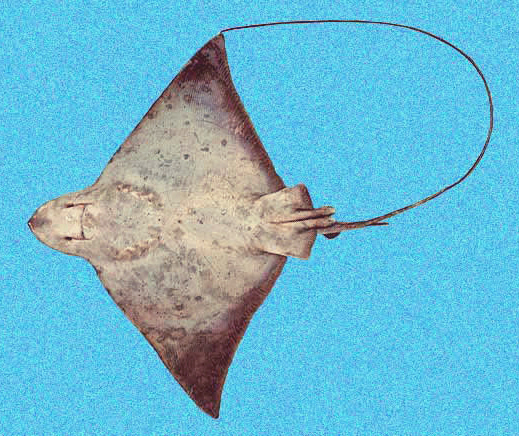
Photo: D Ross Robertson / Smithsonian Institution, Smithsonian Institution — Public domainLong edge is 519px, below this project's 1600px preference. Accepted because it is the best rights-clear, correctly-identified photo found for this species — see SPECIES_PHOTO_AUDIT.md for the source search record.
- Habitat
- Chesapeake Bay
- Methods
- Inshore boat
- Difficulty
- intermediate
- Eating
- Usually released
Identification
Look for
- Projecting snout with NO central notch or indentation — the key field mark separating it from the very similar cownose ray, whose snout is distinctly two-lobed
- Long, sharply pointed pectoral fins ('wings') and a long, thin tail with a venomous barbed spine near the base
- Gray, reddish-brown, or dark brown above with diffuse white spots smaller than the eye; white below
- Smaller at maturity than cownose ray (up to about 42" disc width)
Local waters
- Nearshore and estuarine waters
- Open Bay waters, often alongside cownose ray
Primarily a boat fishery here — typically fished by inshore boat.
When to fish
Warmer months, in nearshore and estuarine Virginia waters — within its documented Massachusetts-to-Texas range.
Tide stage for this kind of water
Rising water on the shallow flats
From: Reading tides without overthinking themWater temperature
The water, not the calendar, sets the season here — a warm October or a cold snap moves these bands.
Water temperature and the seasonsHow to catch it
Primarily a boat fishery here — typically fished by inshore boat. Technique notes for this species have not been written yet; the baits and rigs below are the documented starting points.
Bait & lures
- Cut bait or crab on bottom — often caught incidentally by anglers targeting other bottom species
Handling and release
Not a food-use species in this guide (catch-and-release or restricted) — release.
- Has a venomous barbed tail spine like other rays — the same low-contact handling applies as cownose ray/southern stingray: avoid handling by hand where possible, cut the leader close to the hook rather than forcing removal if the hook isn't easily reached, and release in the water rather than on sand or a pier deck. If you can't confidently confirm the snout shape (notched vs. unnotched), that uncertainty doesn't change the handling approach — keep hands clear of the tail spine regardless of which ray it turns out to be.
Where to try
